
When I began homeschooling 8 years ago, I taught my son handwriting from the same curriculum I had used as a child…D’Nealian.


My son did quite well with them. However, I noticed as he grew older, he began to abandon the D’Nealian cursive I had so painstakingly taught him. He went back to a form of manuscript that oddly enough, looked much like his father’s handwriting.
When it was my 2nd child’s turn to learn handwriting, I did what any good homeschooling mother does…second-guess herself!
I searched for something a little less frilly in the hopes it would be easier for her to retain. Initially, I tried Handwriting Without Tears, but quickly realized some children forget to read the “Without Tears” part and still manage to struggle with it.
I also tried very simple, rather dull little handbooks, but they were just that…dull.
What I ended up landing on A Reason for Handwriting.
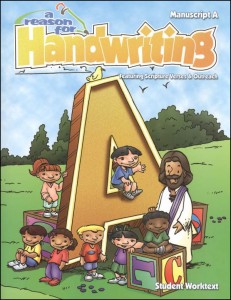
Another homeschool mom was using it and told me about the pages in the back of the book that were for writing out the Bible verse at the end of the week. She told me how her children would send those verses to their grandparents with a letter written on the back of the sheet. All this made handwriting something relevant in the child’s life…exactly what I wanted! Megan did quite well with it and loved having a beautiful finished project each week.
Now, before you run out and buy this curriculum, I must tell you I firmly believe you can teach your child handwriting WITHOUT a workbook. I also must add here that my littles are NOT doing A Reason for Handwriting because their Phonics curriculum (which I adore and will tell you about in another post) has a built-in handwriting section to it.
I am also going to make a rather bold statement here about handwriting in general that will qualify WHY I think you can teach your child handwriting without a workbook:
EVERYONE finds their own handwriting style.
Mine looks like a mish-mash between manuscript and cursive. My mom’s is a rounded looking all cursive hand. My sister’s has a modern, slightly jagged flair to it. My husband writes all manuscript (except for his signature). And we’ve all laughed about our doctor’s handwriting! Yet, every single one of these people was taught some form of handwriting that was supposed to look like everyone else’s.
Cursive has its place. It is a way to write quickly and to learn to read other people’s handwriting; however, it is not the be all end all. Teach it. Then let your child find their own expression in their handwriting!
I definitely think you should emphasize neatness, but if in the end, your child’s handwriting looks very little like what you taught them, don’t fret! Can they write quickly? Is it legible? Can they read other people’s handwriting? Those are really the things that matter here. Not if they have learned to exactly copy the workbook’s way of writing.
OK, quick word on how to teach handwriting without a workbook (once again, keep in mind I DO use a workbook and someone here might leave a great comment about how they make it work in their homeschool…so be sure and scroll through the comments section! The information I am offering below is based on what I have read about teaching without a workbook):
*Teach the lowercase alphabet first.
*Write out in your own hand the letters and help your child trace them.
*Give them lined paper to practice making those strokes.
*From there, give them simple copywork. Begin with one word, then move to two word sentences, then to longer sentences, etc.
*When they ask how to spell or write something, don’t just do it for them. Write the word they want in pencil on a separate piece of paper for them to copy onto their page.
*Have them write letters to grandparents and friends, grocery lists, how-to lists for siblings, etc. Make handwriting relevant!
That last sentence is key to all of this Lifestyle of Learning stuff…
Make learning relevant!
No matter what subject it is, impress upon your children the WHY behind what you are teaching. Children know when they are being duped into following a line of busy work. They also have an uncanny way of zoning out when they believe what they are learning has no reason behind it, no matter how noble your motives might be. Give them meaning. Give them true wisdom! Tell them how God Himself used handwriting!
And the sooner you can walk away from the workbooks, the better!
So, how are you teaching handwriting as a way of life, rather than something random in a workbook?
What is a Lifestyle of Learning? Read about our homeschooling philosophy and the other posts in this series HERE!
marla says
I wish someone had told me this about a year and half ago! LOL! I am homeschooling my oldest (first) and I spent all of last year trying so hard to get her to copy the letters properly. She is a free spirit and wants to do it her way. I have heard of that Handwriting without Tears curriculum and wondered how it is ever POSSIBLE to do it without any tears ;P No, actually it is not that bad, but we have struggled. Finally, I started saying, “This is the proper way to write it, but you can write it however you want to as long as it we can recognize it.” The reason I started saying that? I started watching my own handwriting and realized I don’t do any of that stuff, I abandoned it long ago. OH how peaceful handwriting has become this year with my allowing her to do it however she wants to. Not to mention, mine has the added stress of learning to write two languages (we are missionaries) and the rules of the other language often are completely opposite of ours. So I decided to really let up and let her do it her way because I know even I have trouble keeping track of which rule goes with which language.
And you mentioned telling them how God himself used handwriting! THIS is such great advice. Part of her curriculum this year is writing the alphabet very neatly and making it into a scroll as we study how they used to very neatly copy the Bible and write it in scrolls. Her pages for the scroll are sooooo much neater than her other work, and she takes it so seriously when I tell her to do it neatly because it is for making a scroll like the Bible was first written!
I love the idea of writing memory verses and turning it into a letter to someone. I’m going to try this because she LOVES to send letters!
One other bit of advice, there are so many free printouts for handwriting on the internet too, so buying a handbook really isn’t necessary. Our stuff is included with our curriculum but I supplement a lot with things I find on the internet. I don’t know how people did this without the internet!
Christina Brown says
I am so glad you posted this. It is something that “worries” me a lot. My children that have been diagnosed with Asperger’s Syndrome both write very uniquely. For instance, Noah forms each letter from the bottom to the top instead of from the top to the bottom and hold his pen/pencil in a fisted position instead of the “tripod grasp”. No amount of trying has corrected this problem and yet he is a wonderful artist and most of his handwriting is legible!
Jordan did not really write legibly until about age 12, but does fine now and can type quite well.
When I find myself worrying about it I notice how many of my adult friends really don’t write what we would call “correctly”. I have come to the same conclusions you draw in this article, but have recently been kind of doubting myself.
Thanks for posting this and reminding me of what I know is true!
Clara says
I could never do handwriting. I write manuscript all the time… so when it came time for my daughter to learn, she and I sat down together to learn it – both of us for the first time in our lives! This made it fun for her as we were both struggling with it and wanted to do our best to get it to look great. Both of us can write well now, and my daughter seems to want to practise with it even outside of school lessons! 🙂 I guess some kids like to learn alongside their parent and that is all the encouragement they need!
Jessica says
I couldn’t agree more! A person’s handwriting is as unique as their fingerprint. I do handwriting on my own from cheapy workbooks from the dollar store and use Five In A Row for the rest.
@marla – I also agree that I don’t know how homeschool could be done without the internet! At least not as inexpensively. If one were very organized and good at planning one could homeschool their children for free (minus materials) with resources from the internet.
Michelle says
Thanks for this post. I am struggling right now to teach a 4 yr old and 6 yr old handwriting. It’s not that they’re not doing well with it. I’m doing D’Nealian. Unfortunately I’ve started them off with capital letters which was a mistake. But you’ve given me a lot of great tips.
Shannon at Living Life at Home says
Amy, I completely agree with you that it’s important to let your children find their own handwriting style and to make handwriting relevant. But also, it’s important to realize that handwriting requires certain fine motor skills that develop at different rates for different children. For my daughters, they were all interested in writing and forming letters early 2 and 3 ish, they wrote on paper, in the sand, in the dirt, on the white board. But my boys had a very difficult time with writing letters until they were 6 and one until he was 8. They could learn the formations using large motor skills like a white board or out in the sand or dirt, but actual writing on paper with a pen or pencil just was too difficult. And it was okay for us to wait until they were ready. And now they write lists, and plans, and all kinds of relevant stuff to them. We still used the workbooks to practice formation, but in tiny doses. But that’s the beauty of homeschooling we can educate at our children’s learning and development rate, and customize their education to grow with them and set them up for success.
Amy says
You are absolutely right, Shannon! In fact, if you have a child who is struggling with those fine motor skills, you can start them with a marker or other writing utensil that requires less “work” and move up from there as their fingers get stronger. Thanks for mentioning this important aspect of handwriting!
Kate says
I notice this difference in motor skills in my two, as well — even though they are quite young (2.5 years and almost 14 months). My daughter was always ahead on fine (and gross) motor skills, while my son is a bit behind in fine (but not gross) motor skills. He didn’t learn to clap or do the pincer grip until well past a year. He still doesn’t point (but does sign/talk!). So yes, some kids, especially boys, may struggle!
Kate says
We haven’t taught this yet, as my daughter’s only 2.5. But right now she will bring us paper and pencils and say “Write words.” She will ask us to write some words that she knows and can read. Sometimes she will try to write them too. She’s written a couple letters before, which is not bad for her age! I think this is how she will learn — simply writing words she likes while we help her. And there’s nothing wrong with that approach, if that’s what the child wants. 🙂
Lisa~ says
I have now taught handwriting to my first 8 children and every last one of them, no matter what I do, starts their letters from the bottom. I can’t stop it.
I love what you said about busywork. Sometimes you just need them to fill time so you can work with another kid and it’s hard to find meaningful things to fill that time. Whew! 🙂 Lisa~
Lindsey in AL says
I didn’t even realize there were handwriting workbooks 🙂 I have used D’Nealian printouts from the internet for both of my boys and have now started my 5 year-old daughter with the same. I didn’t start until she had been trying to copy other people’s writing for a while (a couple months probably.) SO I guess that’s one way of making handwriting relevant- wait until the child has a genuine need/desire for it. Of course, I don’t hold that way with everything or they’d probably never learn to add 🙂 Some of the first copywork they did, once they’d worked through each of the letters, was to write thank you notes. They’d tell me what they wanted to say and I’d write it out for them to copy.
Like Lisa above, my kids always start out forming their letters from the bottom-up but they usually get over that without to much frustration. What’s interesting to me is how much fine motor coordination seems to have to do with it. I started my boys when they were 4 and 6 doing all the same lessons. It took my oldest about 6 months to have very neat and legible handwriting and it continues to improve. He’ll be learning cursive soon because he wants to. My younger son has finally started writing in a normal size (instead of something like a 72 point font) but he still writes really hard and traces over the letters several times as he goes. I think some of it is his personality but a lot of it is just the fact that he isn’t as fine motor skill oriented as my older son. He’s a big, bold actions kind of guy (throwing himself off large things, bicycle tricks, etc) while his older brother is a more introspective and homebody type. The younger one learned to ride a bike before his 4th birthday but the older was at least six and a half. I love having 5 children- it makes the differences in all of them that much more amazing and fun to watch for!
Missy says
Very simply…I just show them how to write something when they ask. That’s it. I didn’t do it this way with my first 2 . All I did was make it hard on all of us. My younger ones are learning as it becomes relevant to their life. I have them write thank you cards when they receive gifts , they LOVE writing notes to their daddy and Birthday cards and letters to cousin who live far away.