
How we follow the Liturgical Church year as a Protestant family. Plus, a free download to help you celebrate!
“To every thing there is a season, and a time to every purpose under the heaven…”
Ecclesiastes 3:1

Holidays have always been something magical to me. When I was a little girl, I would sit in our lamp-lit living room, staring into the creche of my mother’s ceramic Nativity scene, imagining that night when Jesus was born and placed in the manger.
Most of my vivid family memories involve the holidays, and more specifically, Christmas. The twinkling lights, the yummy foods, the yearly traditions have become embedded in my mind in the form of smells and tastes and emotions I pray I never forget.
As a mother to many children, I wanted to keep that magic alive through our own family traditions. Christmas seemed like the easiest place to start. (Perhaps I intuitively knew this is also where the Church Year begins!)
In 2008, we started our Jesse Tree tradition. We have added more Advent activities and even a Christmas focus to our homeschool over the years.

Then, in the Spring, I began to add in Lent and Holy Week activities like our Resurrection Garden and Stories of the Resurrection.

These traditions became so precious to me and my family that I craved more! I began to study the Biblical feasts and how Jesus had fulfilled the Spring feasts – something I had never heard of or understood! Then, via a Catholic friend, I realized their entire year is focused on retelling the story of Jesus. That intrigued me. And I began to wonder what celebrating a more Christo-centric year might do for my own faith and family.
I grew up in a church that had some semblance of liturgy – certain readings, changing colors on the altar, a Christmas Eve vigil, and a Holy Week full of somber activities; however, I didn’t know much of the Christian calendar outside those things, and could not have even told you why we did many of the things we did in our denomination.
As Protestants, we have lost much of the richness of history and focus that comes not only from the liturgy of the early church as they walked through the life of Jesus and remembered the early saints, but also from the symbolism of the Jewish feasts established by God for Israel. We are missing out on a calendar year rooted and grounded in the Bible.
It is a deep loss indeed.
Over the last several years, I have been gathering more and more information about the church year, also called the liturgical calendar, and how it applies to not only Catholics, but Protestants alike. I have found myself hungry and thirsty to learn more and implement more of this rhythm of days into our home life, teaching my children the story of redemption through Jesus’ birth, life, death, and resurrection, repeated over and over again, year after year.

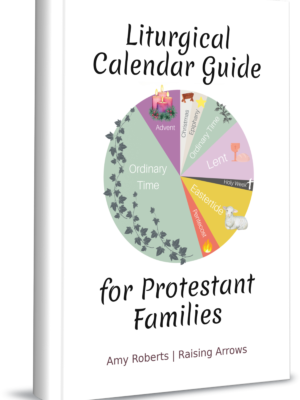
You can download the Liturgical Calendar Wheel you see above as my free gift to you! I have mine displayed on the dining room wall where we do school to remind me of the cycle through the seasons of the Church Year.
Over the summer, I gathered a multitude of books and resources, and began work on a Liturgical Calendar Guide for Protestant Families based on my own study, research, and desire to share certain aspects of the Church Year with my own family. It has been a lengthy labor of love, and I am thrilled to be able to share it with you!

When I realized it would be difficult for me to update and expand the pdf download, I decided to also create an online site called Celebrating the Church Year that would be ever evolving and would include videos, downloadable resources and more!
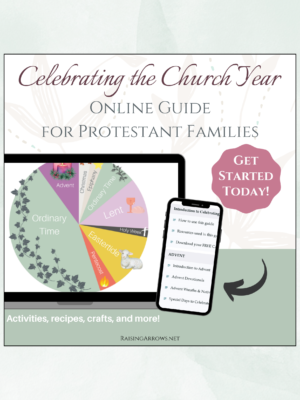
Living our year through a Liturgical Calendar gives us an opportunity to preach the Gospel to ourselves and our families over and over again. It keeps our faith fresh and living and it gives our families a foundation of celebrations that are faith-centered!
What is included in the Liturgical Calendar Guide:
- A season by season, holiday by holiday guide that follows the birth, life, death, and resurrection of our Lord, Jesus Christ and the early church fathers.
- Ideas for foods, crafts, family activities, and resources to help you celebrate a Christo-centric year.
- The Liturgical Calendar Wheel printable.
- A list of the resources to help you create meaningful traditions with your family.
What is included in the Celebrating the Church Year Online Guide:
- All of the above, plus…
- The Liturgical Calendar Guide download
- An additional Calendar Wheel with an expanded Epiphany season
- My Family Worship Guide!
- Video resources to help you and your family make these seasons even more meaningful. For instance, walk the island John was exiled to and listen to Advent Playlists!
- Recipes, crafts, and so much more! And these are always being expanded and updated!
What is not included in either guide:
- Celebrations that I did not feel were relevant for my family – mainly those celebrating saints I was not familiar with and aspects of Catholicism which are not included in the canon of Scripture.
- Anything that is not expressly in Scripture pertaining to Jesus’ life.
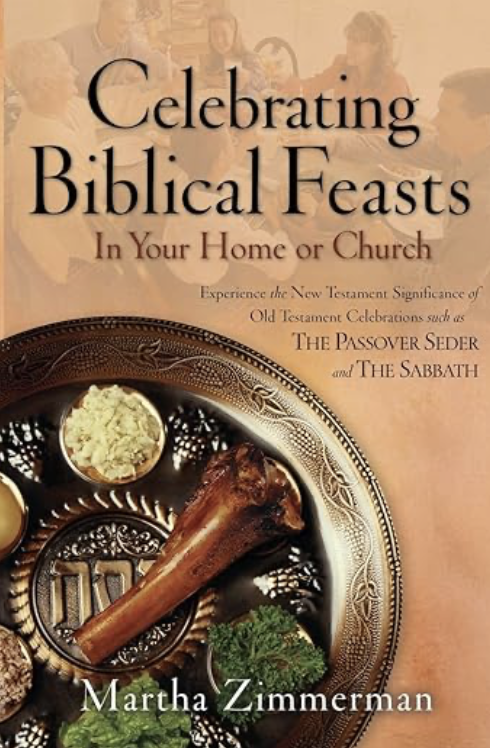
- Biblical feasts – I feel like this is a project in and of itself that I am still exploring, but in the meantime a fantastic book exists that needs to be in every Christian’s home library – Celebrating the Biblical Feasts.
I also highly recommend as a devotional for yourself, Living the Christian Year by Bobby Gross. It is where I started, and the devotional I use year after year.

And my friends NOW is the perfect time to begin exploring the liturgical calendar! It truly does not matter what time of year you start exploring the Church Year!
NOTE: Be aware that the Liturgical Calendar Guide and the Celebrating the Church Year Guide are chock full of ideas, and you should not feel compelled to do them all. Add a few things in this year, add a few more in next year. Little by little build traditions that are focused on the Church Year, and you will eventually have built a home of faith-filled traditions with Jesus Christ as the Cornerstone!
Here’s an excerpt from the Advent section of the Liturgical Calendar Guide for Protestant Families, so you can get an idea of how the Guide is laid out. In the online version, there is more information, plus videos and other resources, all of which are in their own sections to make it easier to navigate.
Advent
The beginning of the Church Year is Advent – the 4 Sundays before Christmas. Advent is not Christmas itself, and it should feel different. It is marked by an “expectant joy.” The Jewish people had been waiting and preparing for thousands of years for the birth of the Savior. We join in their waiting during Advent, and consider our own waiting and longing for the Savior’s Second Coming. “Come, Lord Jesus!”
Of course, many argue that December 25th could not possibly have been Jesus’ actual birthday and that this date was chosen to appease pagans who were used to celebrating the winter solstice (the darkest day of the year); however, as Christine Curley writes in her book, The Church Year at Home, we cannot miss the significance and symbolism of celebrating how “Jesus, the Light of the World, entered the darkened world.” Rather than getting caught up in specific dates, consider this an opportunity to celebrate the Light appearing in our darkness!
Liturgical color = Violet (representing the regal coming of the King as well as a time of repentance.)
Ideas for celebrating Advent:
- Finish shopping before Advent so that you are not consumed by Christmas consumerism during this time.
- Make crafty decorations throughout Advent: popcorn strings, nature-based decor
- Slow down and savor the season.
- Limit the sugar intake and party intake – we are not celebrating…yet.
- Sing carols that speak to the coming Messiah and the expectancy of Christmas.
- Use Advent to clean out toys to give away.
- Do a Sticker Advent Calendar or LEGO calendar rather than candy.
- Make a Giving Box – Decorate the box as a family and encourage everyone to add money to the box to give to a favorite charity or family in need.
- Plus, so many more ideas!
These Guides will walk you through the entire Church Year from Advent to Christmastide with expectancy and rejoicing, from Lent to Holy Week and Eastertide with repentance, sorrow, and celebration. There are activities for Pentecost, the Ordinary Time of Summer and Fall, celebrations focused on the writers of the Gospels, and so much more!
I have so enjoyed studying about the Church Year and putting together these resources. It has brought me to a stronger relationship with our Lord and Savior, and I pray it does the same for you and your family!
Whitney says
I encourage you to read “the Jewish roots of the Eucharist”. You’ll find that Catholicism did not try to get rid of Judaism, it’s just that the old law has passed away. We are under a new covenant and, because it is fulfilling the law proclaimed by the Jewish prophets, it still has deep Jewish roots.
This book and post reminds me a lot of myself 10 years ago. 🙂 I think you’ll find this book very interesting.
Diana says
I am enjoying the Liturgical Year Guide very much. Thanks for all your hard work, Amy!!
Diana says
P.S. A blog that has taught me so much about the liturgical year is “Like Mother, Like Daughter.”
Amy says
Thank you! I will check that out!